The five arrangements at a glance
| Type | Heat from | Heats | Outdoor works |
|---|---|---|---|
| Air-to-water | Outside air | Radiators or underfloor, and hot water | An outdoor unit on the ground or a wall |
| Ground source | The ground | Radiators or underfloor, and hot water | Trenches or boreholes; the unit sits indoors |
| Water source | A lake, river or pond | Radiators or underfloor, and hot water | A collector in the water |
| Air-to-air | Outside air | Room air directly; no hot water | An outdoor unit plus indoor units |
| Hybrid | Usually outside air, plus a boiler | Radiators and hot water, shared with the boiler | An outdoor unit; the boiler stays |
Air-to-water: the usual choice
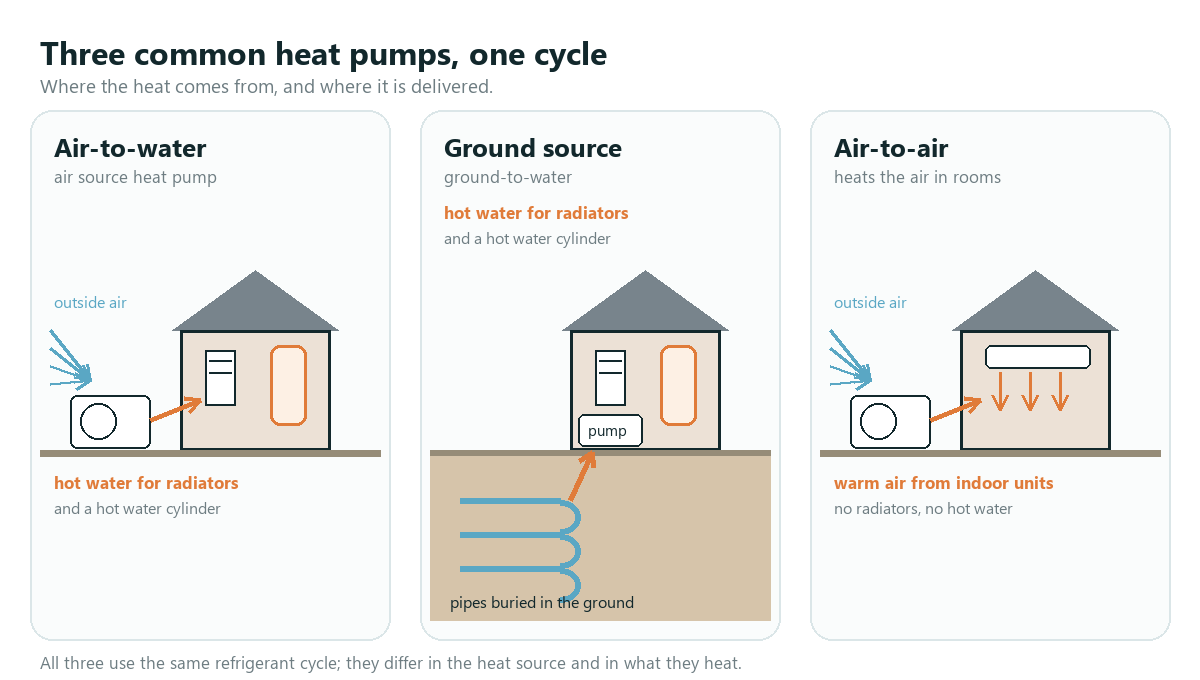
When people in the UK talk about getting a heat pump, they usually mean an air-to-water air source heat pump. An outdoor unit, about the size of a large suitcase or two, holds the fan, the evaporator coil and usually the compressor. It sends heat into the home's wet heating system, the same radiators or underfloor pipes a boiler would heat, and into a hot water cylinder.
Its advantages are practical: no digging, a relatively small footprint, and the ability to work with an existing radiator system, sometimes with some radiators upgraded. Its efficiency falls in cold weather, because it is collecting heat from cold air at exactly the time the home needs most. The grant data shows what heat pumps most often replace: among those funded by the Boiler Upgrade Scheme in England and Wales, the previous fuel was mains gas in 55% of cases.
Ground source: steadier, more work to fit
A ground source heat pump collects heat from the ground through a loop of pipe filled with water and antifreeze. The loop goes in horizontal trenches across a garden or field, or down one or more vertical boreholes where space is short. The heat pump unit itself sits indoors, often in a utility room or garage.
The ground a metre or two down changes temperature far less through the year than the air does, so a ground source system has a warmer, steadier source on the coldest days. Against that, the groundworks cost more and need space or drilling access. The comparison page goes through the trade-offs.
Water source: where there is water
A water source heat pump works like a ground source one, but its collector sits in a lake, river or large pond. It suits few homes, because it needs a suitable body of water nearby and the right permissions to use it. Where it fits, water can be a good heat source because it holds heat well.
Air-to-air: heating the air, not the water
An air-to-air heat pump has an outdoor unit like an air-to-water system, but delivers heat through indoor units that blow warm air into rooms. Most can also cool in summer. It does not heat water, so the home needs a separate way of making hot water, and it does not use radiators. It can suit a home without a wet heating system, a flat heated by electric panel heaters, or a single large room.
GOV.UK says the Boiler Upgrade Scheme can contribute £2,500 towards an air-to-air heat pump in a home. Home Energy Scotland's scheme does not fund air-to-air units, because it requires the heat pump to meet all of a home's heating and hot water.
Hybrid: a heat pump with a boiler
A hybrid system combines a heat pump, usually air source, with a boiler, usually gas. A controller decides which to run, often based on outdoor temperature, demand or price. It can suit a home where a heat pump alone would need more changes than the owner wants to make. GOV.UK says the Boiler Upgrade Scheme does not fund hybrid systems, and Home Energy Scotland excludes them too. The hybrid guide covers how they work.
Choosing between them
For most homes with radiators, the choice is between air-to-water and ground source, and the deciding facts are outdoor space, budget and how much disruption the owner will accept. Air-to-air suits homes without a wet system. A hybrid is a halfway house. Which homes suit which is covered in is my home suitable?, and Home Energy Scotland's terms, including its £7,500 grant for qualifying heat pumps, are on its website for homes in Scotland.
Other variations you may meet
A few less common arrangements turn up in product lists. Exhaust air heat pumps recover heat from the stale air extracted from a home's ventilation system, which suits some very airtight new builds. Shared ground loops connect several homes to one ground array, each with its own heat pump. And "monobloc" and "split" describe how an air-to-water system is packaged: a monobloc keeps all the refrigerant in the outdoor unit and sends water indoors, while a split runs refrigerant pipes to an indoor unit. The cycle inside each is the same one described in how heat pumps work.
Whatever the type, the factors that decide how well it performs are the same: the size of the system against the home's heat loss, the flow temperature, and the controls.
The glossary defines the terms used here in a sentence each.